

An international star whose name is still synonymous with shooting prowess and accuracy, Annie Oakley became a legend in her own lifetime.Her story, often wrapped in mystery and exaggeration, lives somewhere between fact and folklore.
Plays and books like Annie Get Your Gun and The Rifle Queen amplified tales of her adventures of killing bears and panthers, shooting a wolf that attacked her, and even stopping a train robbery in progress. With each retelling, the legend of Annie Oakley grew to epic, international proportions.
READ NEXT:Steve Harvey's Dream to Hook Kids on Fishing and Brighter Futures
What many people don’t realize is that hunting shaped far more than her reputation. It helped her escape extreme poverty and a childhood that bordered on indentured servitude.
Annie Oakley Learns To Hunt
Born in 1860 as Phoebe Ann Moses, Annie Oakley entered the world in poverty. When her father died in 1866, the family’s situation worsened. Her mother, unable to support all the children, sent them to live with neighboring families. Annie was placed at the Darke County Infirmary, a county poorhouse for the sick and mentally ill.

Not long after, she was sent to work for a local family to help with housework. She later referred to them only as “the wolves,” a name that hints at the abuse she endured there. Hunting and shooting became more than skills. They gave her time outside, space to breathe, and a break from the hardship that defined her daily life.
From a young age, Annie showed unusual talent with a rifle. “I was eight years old when I made my first shot, and I still consider it one of the best shots I ever made.” In her autobiography, she described steadying her father’s old muzzleloader rifle on the porch rail and dropping a squirrel from a fence with a clean head shot. “I don’t know how I acquired the skill… I suppose I was born with it.”
Annie the Market Hunter
In her early teens, Annie turned to one of the few ways she could earn money with the skills she had: market hunting. Long before she relied on a firearm, she sharpened her woodsmanship by setting traps to put food on the table. The traps helped, but she soon realized a gun would bring a better return.
Like any new hunter, she had to learn the hard way. As Eileen Litchfield of the Annie Oakley Center Foundation explained, “She took her father’s percussion rifle… She stuffed it so full of gunpowder that the force of the shot from the butt of the gun broke her nose, but she shot a rabbit.” It was a painful lesson, but she learned quickly. With practice, she became a steady, disciplined shot and built a reputation locally as a talented hunter.
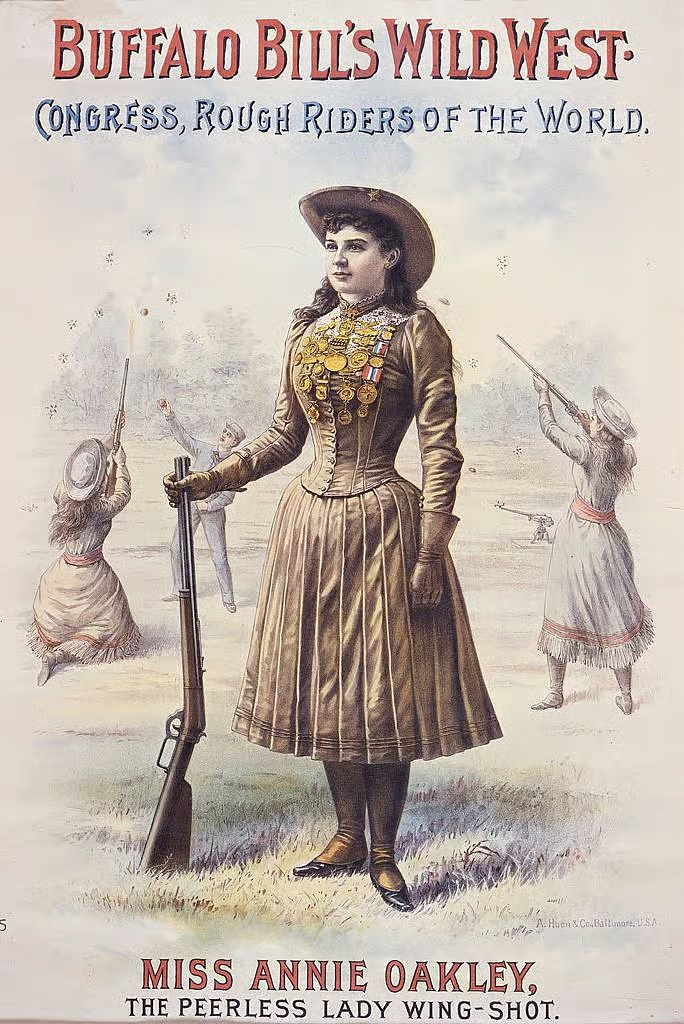
Using her father’s old Kentucky rifle, Oakley would hunt game for the local grocery store, which then resold the meat to hotels and restaurants. According to legend, her accuracy bordered on surgical. She often took her game with a head shot, preserving as much meat as possible and increasing its value at market.
In an era with no game laws or limits, Annie brought in a staggering number of animals. In a single autumn, she was said to bring in between 150 to 200 whitetail deer. Despite those shocking numbers, she refused to be a “gamehog” and imposed her own limits in the field.
She was so successful that by the age of 15, she was able to pay the $200 mortgage on her mother’s house with money she earned hunting. The woods and fields were not just her workplace. They were where she felt most capable and most free.

Her Reputation Spreads
Before long, her reputation spread beyond her hometown. A Cincinnati hotel owner, J.B. Frost, arranged a shooting match between Annie Oakley and the traveling marksman Frank E. Butler. What began as a contest would change the course of her life. The match launched her into professional show business and introduced her to the man who would become her husband.
The two shared more than stage chemistry. They were serious hunters, especially when it came to upland birds. One hunting companion once said, “Miss Annie’s so quick with her gun that if you want to get a shot at a bird you must shoot mighty quick or wait til she misses, and that may keep you waiting some time.”

Her interests stretched beyond bird fields. She was said to have killed and skinned a seven-foot rattlesnake and to have stalked black bears in Florida’s Ocala National Forest.
Annie Oakley, the Trick Shooter
Taking the lessons she learned while shooting at running deer and wing-shooting quail, Annie pushed her skills into more elaborate trick shooting. She taught herself to shoot with both her left and right hands, and she could handle a pistol, a rifle, or a shotgun with equal confidence.

At 90 feet, Annie could shoot a dime tossed in the air with a .22. She could slice the thin edge of a playing card, and then puncture the card with five or six more shots before it hit the ground. She could even uncork a bottle with a single shot.
Yet for all the spectacle, her heart remained in the woods. In her autobiography, Oakley wrote, “I truly long for the day when my work with the rifle and gun will be over with, and when I can take to the field and stream…”
At the height of her fame, Oakley performed for European royalty and titans of industry on stages trimmed in gold and jewels. But her story began in the blue-collar fields and forests of Ohio, where she hunted quail, rabbits, and deer. Market hunting did more than sharpen her aim. It lifted her family out of debt and laid the foundation for her rise as one of the world’s first female international celebrities.
READ NEXT: Q&A With Beretta’s Full Metal Jessy


